
- HOME
- TRENDING
- PEOPLE
- COMMUNITY
- LIFESTYLE
- OUR PUBLICATIONSOUR PUBLICATIONS
- MASALA RECOMMENDS
- MASALAWEDS
By Sanita Baig
It’s Sunday night, and you are out for a family dinner at your usual Italian restaurant. You know, the one where the waiters know not to put ice in your water and patiently jot down your order as you modify every dish to make it vegetarian, less salty, and extra spicy.
Uncle and Auntie are visiting from overseas, which means tonight is not a normal dinner but a spectacle. Extra platters appear, nothing is off limits, and desserts are non-negotiable, even though everyone insists they cannot eat another bite.
Then, the bill arrives.
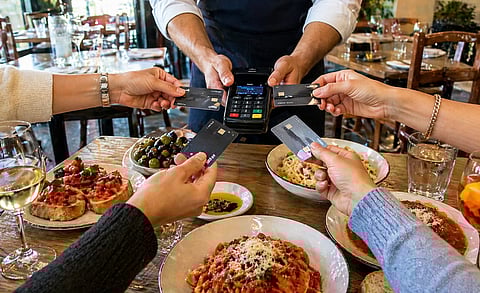
Overseas Uncle motions for the waiter to bring him the check, while Local Uncle recoils in horror that the guest of honour would even offer such a thing. The Uncles debate with wallets dramatically waved in the air; arguments ensue about who ate more or less; wives cheer their husbands on from the sidelines, while the waiter stands there awkwardly, wondering when his shift will be over.
Finally, Local Uncle triumphs. He presses his credit card into the waiter’s hand with a celebratory smugness. Overseas Uncle graciously accepts defeat and says they must come visit so he can treat the others to an equally elaborate meal.
Meanwhile, in other cultures, diners look at the bill and calmly say, “Shall we split it?” That is, if they haven’t already asked for separate tabs at the start of the meal.
Paying the bill among Indians can be a spectator sport, driven by a mix of generosity, ego, and cultural expectations. Community members tell us what really happens when we say, “Check bill.”

Who pays: Growing up in New Delhi, as a child of the 80s, I learned that the father was typically expected to pay. That was the norm in many households at the time, where financial responsibility was largely seen as the father’s role.
Friends versus family: When going out with friends, the bill is usually split among everyone. But with family, it’s more informal. Often, the person who receives the bill ends up paying for the whole group.
Personal paying preference: Personally, I’m okay with splitting the bill. I don’t like getting into the details of calculating individual amounts. For me, it keeps things simple and stress-free, whether I’m out with friends or family.
Origins of the ritual: I think a lot of it comes from what people have grown up seeing, so they naturally copy that behaviour. But people really do want to pay as a way of showing care.
When dining out among Indians, people are generally comfortable splitting the bill equally. This is also influenced by the nature of Indian food, which is often shared among the group, making it feel more natural to divide the total evenly.
In Thailand, I see a similar version of this, too. It’s common for older people or bosses to pick up the bill. It’s a way of showing care, generosity, and a sense of responsibility. In some other cultures, I’ve noticed that people tend to prefer getting their own bill and paying only for what they ordered, which keeps things clear and fair for everyone, too.
Best bill battle: One of the funniest things I’ve seen, especially back in India, is how the men in the group would almost fight over the bill. As soon as the bill arrives, two or three people reach for it at the same time.
Someone might even stand up and walk quickly to the counter just to pay before anyone else can. At the same time, they keep insisting, “No, no, I’ll pay,” or “You paid last time, let me get this.”
In the end, whoever manages to hand over their card or cash first “wins,” and the others just laugh and say, “Alright, next time it’s on me.”
Who pays: Growing up, I was taught that the person who invites should usually pay the bill. In many Indian families, there’s also a strong influence of traditional gender roles, so men are often expected to pay, especially on dates or when hosting guests.
At the same time, there’s a cultural emphasis on generosity and hospitality, so people often insist on paying as a way of showing care and respect.
Friends versus family: When dining with friends, the approach is usually more casual. Splitting the bill is very common, especially among younger groups. There’s often a playful, “I’ll get this one, you get the next.”
Within the family, traditionally, either the eldest or the host pays. Younger members may offer, but it’s usually refused as a gesture of care. In modern families, adult children sometimes insist on treating rather than being treated.
With friends, it’s about fairness. With family, it’s about care.
Personal paying preference: I usually prefer to pay for my own items, especially in a formal group. It just feels fair. That said, if it’s a close group or a casual outing, I’m completely happy to split the bill equally.
It lets everyone focus on enjoying the time together rather than the math.
Origins of the ritual: In India, paying the bill is a competitive sport disguised as generosity. Hosting someone, insisting on treating, or even sneaking off to settle the bill quietly is seen as a gesture of care, pride, and respect.
It’s less about splitting costs and more about “I’ve got this” as a way of expressing affection.
In contrast, in many Western cultures, there’s usually a stronger emphasis on clarity and fairness. People are more comfortable splitting the bill, paying for exactly what they ordered, or even stating preferences upfront.
It’s practical, transparent, and avoids any awkwardness.
Best bill battle: I once saw two uncles turn paying the bill into a full Bollywood climax. The moment the bill arrived, both lunged for it like it was the last train home.
One slipped away “to wash his hands” and secretly paid. The other quietly handed his card to the waiter, saying, “Don’t tell anyone.”
Two minutes later, both returned looking victorious until the waiter announced, “Sir, the bill has already been paid.”
“What have you done?!”
“You are my guest!”
“No, YOU are my guest!”
The rest of us sat there watching the drama unfold like live entertainment.
Who pays: Paying is an act of hosting. And playing host is very important to our culture. When we have guests at our house, we shower them with sweets, snacks, juices, and drinks.
It’s part of Indian culture to host lavishly and not hold back for guests. That level of courtesy is extended to when we host people outside the house, hence our insistence to pay, which has now evolved into an art form in itself.
Friends versus family: With friends, I was introduced to the concept of “going Dutch” (paying only for what you personally ate), though this is much more of a hassle to coordinate in Bangkok compared to U.S. restaurants.
With family, it’s hierarchical. As a child, the “grown-ups” always paid. If it’s a large family gathering with a shared agenda, the grown-ups split the total equally based on the number of families present.
Personal paying preference: I’m a grown-up now, so just split it without stressing over the financials. I have some thoughts about paying on dates, though.
On a first date, the moment the check arrives, it determines whether a second date is on the cards. As the guy, the default move is always to reach for the bill. The girl’s reaction is where the story is.
If she nods and smiles, she likely expected it. This might not be the person you want a second date with. Why? Because she didn’t do the dance. Even if the expectation is for the guy to pay, she should make the move to split.
Our ancestors didn’t cross the Indus River into fertile lands and fight for universal suffrage just for her to sit back on her hands. You want someone who demonstrates they aren’t looking for a free meal.
However, if she insists on splitting the bill, pay attention. This is often a tactical signal from her that the evening is purely platonic.
Having established all these arbitrary rules, though, sometimes a split is just a split. On my first date with my wife, she insisted on splitting the bill, and we did. I was fine with it because every other sign pointed toward the night being a massive success.
Origins of the ritual: It is our parampara (traditions). A customary dance. While it might be arbitrary, it is a vital way to stay connected to our roots and celebrate the people at the table.
It isn’t just about the money; it’s a performance of affection and refusal to forget the traditions of where we come from.
Best bill battle: When cousins visited from overseas, we could expect the “bill dance” to occur. My father and his cousin, rounding and observing each other, from sneaking the subtle nod to the waiter to the swift jump to snatching the bill when it arrives.
And after hours of negotiating who would have the honour to pay based on a very biased argument, the other would reluctantly agree.
The most fun for us kids was the eventual conclusion to have a follow-up dinner, so whoever missed paying first can get a chance to treat the other, and the kids have another dinner to hang out with the cousins.