
- HOME
- TRENDING
- PEOPLE
- COMMUNITY
- LIFESTYLE
- OUR PUBLICATIONSOUR PUBLICATIONS
- MASALA RECOMMENDS
- MASALAWEDS
Roti, kapda aur makaan; food, shelter, and a piece of cloth to cover our nakedness and protect us from the elements, were and remain the primary needs of humankind, right from our earliest predecessors to the modern you and me of today.
Albeit, with the “me must be best” mindset, ‘need’ has unfortunately morphed into want; an insatiable desire; more is never enough, and the better it gets, a little better it should become.
Our dwellings got bigger, but we dwindled to just the nuclear family living under one roof, and yet, more and more estranged and isolated from each other.
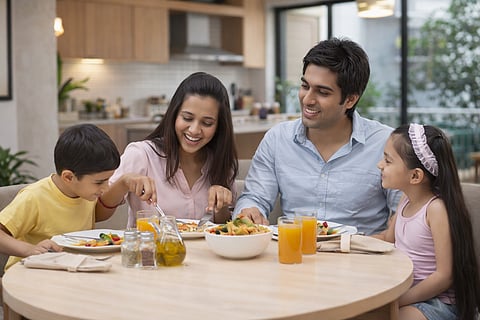
The mundane and ordinary routine that most of our generation took for granted, one of sitting together around the table to share the freshly-made, nutritious, and tasty food coming out of the kitchen, is now becoming more and more of a rarity.
In too many homes, the members are seated in distant corners, noses to their mobiles or laptops, munching on a pizza or waiting for a take-out from some fast-food franchise; a culture we’ve welcomed onto our tables and into our guts.
We’ve even elevated junk food to the status of ‘special treat’ for our children.

Sitting to eat together wasn’t just about filling our bellies.
It’s where we talked, shared our lives’ ups and downs, turned up our noses at what was made, but were told to eat it anyway.
We gossiped without worrying, discussed issues of the world, fought and argued some, but forgot about it the next morning.
Amidst the very many chatty, chaotic mealtimes that we shared with family members of different personalities, with strong opinions of their own, we found a niche of our own and became the unique individuals we are today.
It was around that table we forged a deep, familial bond, and from the depths of our hearts, knew that we’d be there for each other, always.
True, eating out and fast-food consumption have been a norm for decades, especially for the youngsters balking at daal and sabji, but it’s only in recent years that we’ve seen a phenomenal rise in the growth of food delivery platforms, boosted further during the COVID-19 pandemic.
The humble kitchen is the heart of any home; it’s where the smells and memories of everything that’s transpired with us linger.
Today, it’s sadly being replaced with an impersonal, ultra-modern, showpiece kitchenette equipped with space-age appliances; too daunting for newbies to experiment with a cake recipe.
Living in an era of excess and abundance and shopping in supermarkets, we’ve collectively forgotten that the aloo roti we gobbled in 10 minutes took months and months of backbreaking, toiling in the sun and the rain of the respective farmers of the ingredients that went into making this irresistible, Punjabi staple.
We also overlook that someone works from morn till sunset, to earn, to put food on the table, under the roof of a place we call home.
It’s easy to rattle off a list of what we’d like to eat, but it’s someone else who’ll go out to buy the stuff. Then, of course, there’s the person standing in front of the hot stove in Bangkok’s sweltering heat, catering to our demands.
Whenever darjee, my father, sat down at the head of the table to partake of a meal, he’d put a hanky over his head, which stayed on for the entire mealtime.
Then, he would bow his head and fold his hands in gratitude to the sustenance the meal was providing him.
Food is sacred; food equals life.
The act of eating should be one of respect and utmost reverence and gratitude.
Eat healthy, shun all distractions for that, while savouring each morsel, note the texture and taste with the awareness that what we are putting into our mouths is not only satiating our hunger but also soothing our spirit.
Furthermore, there’s nothing that can nurture as genuine a sense of belonging and security as sitting around the dining table with the family to share a healthy, home-made meal.