
- HOME
- TRENDING
- PEOPLE
- COMMUNITY
- LIFESTYLE
- OUR PUBLICATIONSOUR PUBLICATIONS
- MASALA RECOMMENDS
- MASALAWEDS
Although every Indian child grew up believing weekends were for maths homework and their destiny was to become a renowned doctor, there are still some basic skills that we have yet to master.
Our Indian ancestors may have given the world things like chess and yoga, but we have a lot of trouble with simple social behaviours like:

Polite and innocent conversation topics with someone you don’t really know is an art form. There are many neutral subjects to choose from, such as the weather, weekend plans, or someone’s hobbies.
But Indians? Within seconds, they have an amazing knack for pointing out your weight gain, that pimple on your cheek, why you aren’t married yet, your unimpressive salary, and that scandal with your cousin last year, who broke off his engagement.
In this brief encounter, they also possibly have memorised the GPS coordinates to your house, plus everyone who lives there.
Once you have had enough of not-so-small talk at a social gathering, you may want to leave quickly. But when you say you are going, that actually means you are starting the process of saying goodbye.
It takes at least 30 more minutes of thanking the host, their entire extended family, an auntie insisting you eat more dessert, and then, before you know it, you are stuck at the exit having a long conversation with someone you just met and making plans to attend their daughter’s wedding next summer in Mumbai.
While Indians can never say bye fast enough at an event, this skill doesn’t apply to phone conversations. The caller has no qualms with talking simultaneously to someone else mid-conversation—their maid to heat up the chai, the driver about where he needs to go, a friend they run into while out, the fruit vendor about discounting prices.
The caller may then hang up without informing you, so they can continue their other dialogue. If they keep you on the line, they will ignore you when you say, “Excuse me, are you talking to me?”
But it doesn’t matter because it usually ends with the caller saying, “OK, OK,” and then an abrupt disconnection.
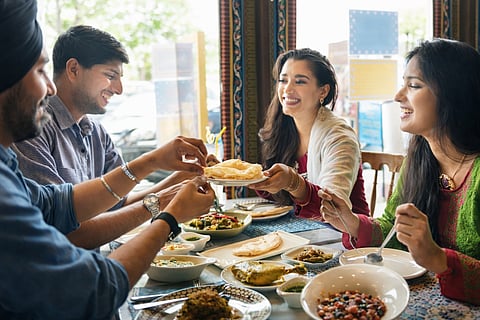
Despite being told you should lose weight to improve your marriage prospects, declining food offered by others simply does not compute. Instead, the host will repeatedly insist that you need three more samosas, and further refusal triggers a panic as to whether you are unwell.
And if you are indeed unwell, more meals will be offered that will cure you of any sickness. So, eat up because this is a food fight you will not win.
Just as the Indian persuasion claims victory when it comes to accepting food, we also have trouble with the word “no”. Say, for example, you have no intention of actually going to Mumbai for your new friend’s daughter’s wedding (the one you met when you were unsuccessfully trying to leave a party).
You receive the invitation followed by messages urging you to attend. Then come the repeated phone calls saying your presence is required. All the while, you respond with, “I will see,” “I will try,” and “I will plan”.
Suddenly, your ambiguous responses are interpreted as a confirmation, and you get catapulted to guest of honour status. Before you know it, you have adjusted your whole life to get on the flight to Mumbai because you couldn’t say “no”.
At least when you are there, you can make deeply personal “small talk”, be overfed, and still end up being the last one to leave the party.