
- HOME
- TRENDING
- PEOPLE
- COMMUNITY
- LIFESTYLE
- OUR PUBLICATIONSOUR PUBLICATIONS
- MASALA RECOMMENDS
- MASALAWEDS

Phahurat, which is known today as "Little India", didn't actually start out as an Indian neighbourhood. Before Indians started operating businesses here, the area was home to Vietnamese refugees who settled in Bangkok during the Thon Buri period. When Rattanakosin was redeveloped, many Vietnamese families were relocated to the Phahurat–Tri Phet–Ban Mor area.
During the late 1800s, Sikh merchants from Punjab began arriving in Thailand, previously known as Siam, for textile trading. This was due to Bangkok's expansion and increasing demand for woven cloth and silk fabrics.
The turning point happened in 1989. It was the year a major fire broke out on Phahurat Road, clearing land for a new commercial road.
Rows of shophouses were built along Phahurat Road, providing the perfect opportunity for Sikh merchants to rent space and operate their textile businesses. The layout worked especially well, with the ground floor acting as a shopfront and the upper floors used for storage and living. This was when they began to consolidate in the area.
In the early 1900s, the textile business expanded. Many Sikh merchants worked as travelling salesmen, carrying fabrics to customers or offering goods on instalment plans. It was one of the best businesses for them at that time because cloth was always in demand, it was easy to transport, making it highly profitable.
Slowly, their families followed, and even more migrants arrived, and as a result, a business network was formed.
In 1933, the Sikhs built Gurdwara Sri Guru Singh Sabha, which became Thailand's most important Sikh temple. But the Gurdwara didn't just become a place of worship, but also a community centre, school, and meeting point for the Thai-Sikh community.
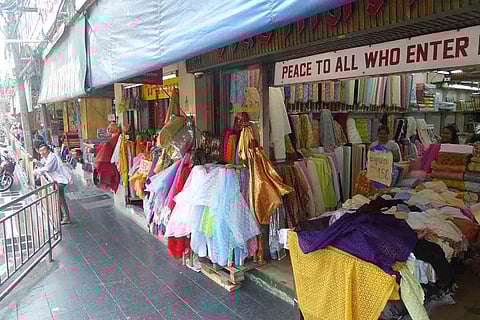
Over time, more and more storefronts owned by Indians emerged in Phahurat, and the area slowly became known for fabrics and garments, saris, and tailoring materials. The district gradually became the main base for Indians working in the textile trade, which is why its identity grew so strongly linked to the Indian community.
Later, the area began to attract other Indian communities like Sindhi, Gujarati, and Tamil traders.
Phahurat developed side by side with nearby Chinatown. The Ong Ang Canal and surrounding markets connected Indian textile traders with Chinese wholesalers, creating a shared commercial zone.
The Ong Ang canal was originally built in the 1780s as a waterway and trade route. In early 2020, the canal area was restored and became one of Bangkok's popular walking streets with delicious Indian restaurants and small eateries.
This area also becomes very happening during Diwali. You will see the streets lighting up with decorations, dances, and food stalls. It attracts locals as well as tourists, turning Phahurat into a cultural landmark and lively commercial district.