
- HOME
- TRENDING
- PEOPLE
- COMMUNITY
- LIFESTYLE
- OUR PUBLICATIONSOUR PUBLICATIONS
- MASALA RECOMMENDS
- MASALAWEDS
By Ishaani Budhraja
“Listen to your mother!” or “I don’t know, ask Papa.” Chances are, you've heard one (or both) of these phrases echo through your home. And, admittedly, parents are usually right... usually.
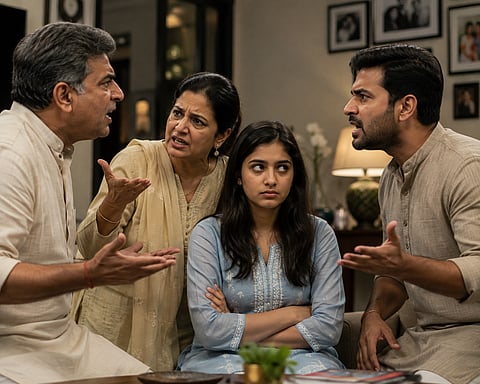
But what happens when your partner is clearly in the wrong and your child actually has a point? Do you back your spouse to present a united front, or stand by your child, even if it means inviting a little more ghar ka kalesh?
Masala took a peek behind the doors of homes across our community to find out: when tensions rise, who do people really side with? And more importantly, how do they keep the peace without losing it themselves?

My wife and I have two grown-up children. Between the four of us, we all have completely different personalities, so disagreements are inevitable. My children are both strong personalities, and so am I.
Thankfully, my wife is much calmer than the rest of us, which helps balance things out. People often ask me whose side I take when my children and I disagree, or when my children and my wife don't see eye to eye.
Honestly, it depends on what we're arguing about. If it's just a general discussion, I'll usually support whoever is making the more logical argument, regardless of whether it's my child or my partner.
But if it's something more serious or emotions are running high, I take a step back first. I listen before deciding anything because every situation has two sides. What's right for me may genuinely feel wrong to them.
As parents, we naturally have more life experience. Sometimes our children can't see the bigger picture yet, so I still feel it's my responsibility to explain why I think something is right or wrong.
They may not always agree with me, but that conversation is important. One thing I've realised over the years is that parenting today cannot be the same as it was when I was growing up.
Back then, fathers were the unquestioned heads of the household. You listened because there was simply no other option. If I tried parenting my children the same way today, it just wouldn't work. Times have changed, and we have to change with them.
That's why I think discussion is incredibly important. I actually enjoy conversations over breakfast or dinner where everyone shares opinions and different perspectives. Those discussions help families stay connected.
What I don't believe in is constant confrontation. Too much ghar ka kalesh slowly creates negativity, resentment and loss of respect. Every family argues occasionally, but it shouldn't become the atmosphere your family lives in.
One of the funniest disagreements we've had recently was over... Alexa.
My five-year-old daughter wanted loud music playing during dinner, while my husband, after a long day at work, just wanted a peaceful meal where we could all talk about our day. He suggested lowering the volume, but she wasn't having any of it.
I'll admit, a part of me was secretly proud of how confidently she stood her ground. At the same time, I wanted her to understand that compromise isn't about losing. It's about being considerate of someone else's needs.
At that moment, I found myself siding with my husband. Of course, while all this was happening, the only thing going through my head was, "Please don't let this end in tears, because then dinner gets delayed, bedtime gets delayed... and that means less Netflix time for me!"
Most of the time, I see myself as the peacekeeper. I joke that I'm constantly mediating between a very big 40-year-old man and a tiny but fiercely opinionated five-year-old.
My goal is never to make one person feel like they've lost. I want both of them to feel heard while gently guiding them towards a compromise.
Sometimes that works perfectly. Sometimes it completely backfires. There have even been moments where my daughter suddenly forgets what she was arguing about, joins forces with her dad, and the two of them somehow end up united against me!
Over the years, I've realised that not every disagreement needs an immediate referee. Children are constantly watching how we handle conflict. They're learning from how we speak, how we listen, and how we apologise.
If someone is clearly wrong, it's okay to explain why, but most of the time, I think our job as parents is to help everyone feel heard. I don't actually believe avoiding conflict is the goal.
If keeping the peace simply means everyone bottles up their feelings, then it isn't really peace. A little ghar ka kalesh is healthy because it means people feel comfortable expressing themselves.
What's important is knowing how to come back together afterwards. That's the lesson I hope my daughter grows up with.
One recent disagreement in our family centred around curfew during the FIFA World Cup. My children wanted to stay out until four in the morning to watch the matches with friends, while my husband wanted them home because he was worried about their safety and sleep.
I honestly understood both sides.
For me, parenting has never been one-size-fits-all. Every child is different, so every situation has to be looked at differently.
Before making a decision, I want to understand where they're going, who they're with, whether they've shown responsibility before, and why they want that extra freedom in the first place.
If they've consistently shown responsibility, I believe trust should be rewarded with freedom. But that trust has to be built from both sides.
When I'm caught in the middle, I never think about who's winning. I think about what decision will keep my family closest in the long run. Taking one person's side too quickly almost always hurts someone else.
The same applies when disagreements happen between adult children and their partners. Just because someone is your son or daughter doesn't automatically make them right.
As parents, we're usually more experienced, but that experience should help us calm situations down rather than interfere unnecessarily. Unless they genuinely ask for advice, I think it's better to let them solve their own problems.
One thing I wish more families understood is that conflict itself isn't the problem. In fact, I think some ghar ka kalesh is necessary.
If nobody ever disagrees, then nobody is probably saying what they really feel. Families become stronger when they're able to have difficult conversations, learn resilience, and still come back together afterwards.
That's what creates lasting relationships, not pretending everything is always perfect.