
Chaos in a Coupe: A Love Letter to Train Travel, Dogs, and Self-Discovery

Undisputedly, the most convenient way to travel is by plane. The ease of checking in, tucking your luggage into the overhead compartment, and sleeping your way across oceans is unmatched.
Before the airplane, however, we had the mighty locomotive. Tracks laid out, spanning across mountains and fields, and a steam engine billowing smoke.
There was a certain romance to train travel; it felt like slipping into a storybook.
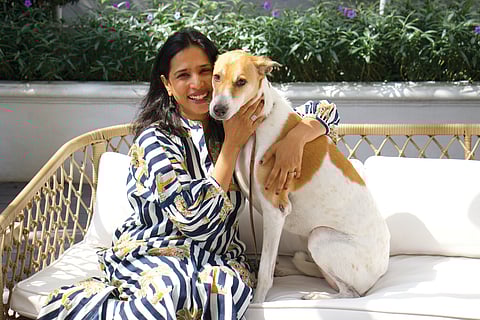
Divya Dugar, writer, journalist, documentarian, and dog lover, knows this all too well.
Her book, Chaos in A Coupe, details her travels with her three dogs and family across the Indian Railways.
Where did it all begin?
I was born into a traditional Marwari family, born and raised in India. Being able to carve out a life for myself as a journalist felt like a miracle, especially since none of the women in my family before me had worked.
As a news reporter, I worked with the French national television to cover news across South Asia, including headlines about terrorist attacks and political upheavals.
From there, it was only natural to transition into long-format documentaries. I made 80 documentaries in collaboration with the French-German television channel, ARTE.tv.
Despite coming from a very patriarchal and traditional family, being able to create this life for myself helped me realise that if you fight enough, you can carve out a life for yourself—one that you want.
In a way, that is what my book is about. It is part memoir about making a living for myself and not going back to my family, but it is also a love letter to my three rescue dogs.
I was 25 when I rescued them, and since then, we sort of became each other’s lifelines.
In addition to this, my book is also a travelogue that looks at what it means to be a woman in India, to claim space in love, in life, on the road, and through travel.
What inspired you to write a book as opposed to blogging or social media, which, in today’s media landscape, arguably has more immediate reach?
Of course, the dogs and our journey are very popular on Instagram. We have over 80k followers, but social media can fizzle out; reels are short-lived; and posts can get lost in people’s feeds.
When you write a book, it lives on forever.
I met my agent through Instagram, and she had been the one who put the idea in my head to write a book. Once my daughter was a little older, that was when I seriously considered writing a book.
Then the passing of my dog, Tigress, really solidified it.
There is an entirely different grief of losing a pet that was your companion for 16 years. You remember the feeling of companionship and of warmth, but sometimes, slowly, you can’t immediately recall the little details.
I did not want to forget a single memory with Tigress.
The Indian Railways have long been romanticised in literature. When you started writing, did you intend for your book to be a love letter to train travel or more of a guidebook?
I think it is a love letter to the railways.
As a child, I travelled a lot with my grandparents by train. I love the idea of travelling in a sleeper train: going to the station, making a list of all the station halts, playing cards, reading books, and eating our way through the journey.
My dogs, especially, are big fans of the Indian Railways pantry. The watery but incredibly peppery tomato soup, the oily paneer and daal, the stiff rotis, and even the vanilla ice cream—it all evokes a sense of nostalgia in me.
I would choose that over a very fancy first class of any airline because I feel this is what travel should be.
If it were possible, I would only take trains.
Was there a reasoning behind which moments of your journey you chose to immortalise in text?
My book is very much about the simple moments. I’m not climbing some unscalable mountain or going to some exotic country.
These topics are overdone, and people have travelled to Goa, Madhya Pradesh, and Rajasthan many times over.
What makes my book a little different is how seemingly ordinary moments are made extraordinary by the presence of three dogs.
There were moments of hilarity in our journeys that I did my best to mention. One such memory was the ‘furry ghostbusters’, which recounts the time my dogs and I went to my ancestral home in Rajasthan.
My mother and grandparents thought that since dogs can sense spirits, they would be able to sniff out any lurking ghosts in the corners.
Despite this, there are moments with a more serious tone as I reconcile how my relationship with my family changed with the arrival of my rescue dogs and how we came into each other’s lives at the right time, and subsequently helped each other heal.
What was the writing process for this book like for you?
During my travels, I had no concept of turning these journeys into a book. Travel is a really saturated market right now.
Everyone tells you, not just where to go but how to experience a place.
I think travelling with my dogs made me see it in a totally different light. There was no guidebook to consult, so every day we discovered a new place; some shacks here and there, little restaurants, and people’s houses.
Although I was working from memory, I did have a list of train journeys I took.
I also had thousands of images of those travels, from the trains to the hotels and places we stayed in. A lot of my references and memories were supplemented by the photos.
Ultimately, this is a book of some of my best memories.
Looking back, if you could give yourself any advice, what would it be?
On 1 October 2016, I took a train from Hazrat Nizammudin railway station to Madgaon.
I was such a nervous wreck. Now, I would tell myself to enjoy the moment.
When I started to write this book, I realised I had gone on one of the most beautiful journeys of my life.
I would also give myself credit for my younger years and tell myself and others, you have to have conviction in yourself.
I would never sugarcoat it; it hasn’t been easy. There was a lot of heartbreak, a lot of tears, but despite it all, there was also determination and a will to power through it.