
- HOME
- TRENDING
- PEOPLE
- COMMUNITY
- LIFESTYLE
- OUR PUBLICATIONSOUR PUBLICATIONS
- MASALA RECOMMENDS
- MASALAWEDS
We Indians have a lot of cultural and traditional rituals and festivities; but there’s a particular one I’m exceptionally fond of; one that gets me all warm and fuzzy and makes me glad I’m born an Indian and that too, as a girl, as a sister. It’s the tradition of rakhri or rakharhi as we, Punjabis say it or raksha bandhan, in Hindi; which, as per the lunisolar calendar, we just celebrated on the purnima or the full moon day of August the 28th.
In both the dialects, the root is the same; raksha, rakhee or rakhri, meaning to guard; protect; watch over; keep safe or defend. Bandhan meaning a bond or a tie; which alone-standing, can be translated as a binding that holds or ties one down; burdensome. But when the two words combine, bandhan with raksha, the connotation flips completely. It then reflects a unique bond/tie; a lifelong one of love and care between brother(s) and us, the amazing sisters. So, then, how we address each other also does not affect the significance of the day; whether, as Punjus, our bros are praji or pa or veer, and we their paen, or if we are addressed as didi or bhaehaen by our Hindi speaking bhai or bhaiya.
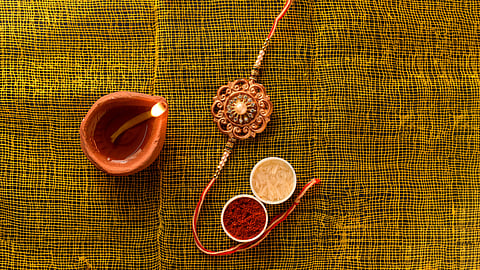
In the earlier days of my childhood, rakhri was inevitably in the early morning hours, before the men went off to their Sampheng offices. That’s because both sides didn’t eat anything before meeting up on this very auspicious occasion. To proceed the sister(s) will cover her head and, in some households, she’ll apply a tikka of saffron paste on the brother’s forehead.
Then, with the respect due him who, irrespective of age, stands in the stead of the common father, she will, then, proceed to tie around the brother’s right wrist, a sacred thread, which was once, literally just a thread in red or yellow, but has blossomed into a multi-million business with tons of options to choose from.
She’ll also, do moo-mitha, sweeten his mouth, i.e. wishing him nothing but the sweetness and goodness of life; the best of everything, by feeding him something sweet, which has also morphed from the simple homemade fare like the rice pudding, kheer or the family’s favorite halwa recipe, to an endless variety in confectionary and exotic Indian mithais.
Meanwhile, the bhai/pa after graciously accepting the rakhee, will reciprocate by giving the sis(s) monetary gifts, while silently, reviving the binding promise to guide and protect his female sibling(s) throughout each other’s respective lifetimes.
What’s so heartwarming about rakhee is, it isn’t limited to just siblings; oftentimes, it includes cousins and close family friends or even a moo-bolee bhaehaen/paen; that female with whom the relationship has grown to become almost sister-like. Better still, in today’s unsettling world, rakhee is tied on to community leaders and soldiers; those people who are safe-guarding and protecting our rights, freedom and sovereignty; their selfless service being the priceless return gift!
This ritual, of tying a thread, though seemingly simple, holds a meaningful significance. This is the one day that both the parties will do everything within their power to meet up in person. It’s when none of them will look back to gripe about not making time to keep in touch with each other, even to just chat on the phone during the whole year, or in some cases, over years at a stretch, due to their respective life’s circumstances.
Sometimes, it’s the physical distance that has somewhat gnawed into the relationship. But, on this day, there isn’t or shouldn’t be a gap wide enough that they forget the shared days of childhood; of shared experiences; where they laughed together and cried together and those little spats and the making-up after.
All other relationships in life are built, but there’s this one relationship that’s destined to be; we are born as siblings, to the same parents and share a blood bond that cannot be eroded, no matter how far the distance in miles or in the connection may be.
