
- HOME
- TRENDING
- PEOPLE
- COMMUNITY
- LIFESTYLE
- OUR PUBLICATIONSOUR PUBLICATIONS
- MASALA RECOMMENDS
- MASALAWEDS
Beneath all that technology, torque, and tax structure lies something far more personal.
For men, and very often women, in our Thai-Indian community, cars were never just machines. They were introductions, insurance policies, and a way of telling the world, and more importantly, our families, “Relax. I’ve thought this through.”
Masculinity, in our world, was never loud. It didn’t scream for attention. It didn’t rev unnecessarily at traffic lights.
It showed up on time, didn’t break down, and could seat six people comfortably, sometimes nine people uncomfortably, and somehow still be described as “very comfortable” by the person who wasn’t sitting on the wheel arch.
And somehow, that was enough. Corona Mark II comes to mind instantly. Solid. Predictable. Dependable.
My mamaji’s BMW E12 5-Series was elegant, but still very much a family car. Aspirational, yes, but never impractical.
Across our community, each garage told the same story: BMW 5 Series, Mercedes E-Class, Peugeot 508, Mitsubishi Galant and Lancer, Nissan Bluebird and Sunny, Honda Accord and Civic, Toyota Corona and Corolla, Volvo 740 and 940.
Sports cars were so rare that if someone had one, news travelled faster through the community than any car ever did on the road.
Conversations followed a predictable pattern: “Very nice car, but speed breaker problem?”, “Petrol is also very expensive—premium petrol only?”, “Service centre nearby or you will cry later?”
Masculinity, at this stage, had a very clear brief: four doors, a generous boot, and absolutely no interest in lap times.

Long before I was born, my father owned a Holden Kingswood V8 in Thailand. Manual. V8. In the 60s and 70s.
Even writing that sentence today feels slightly illegal.
This wasn’t bravado. It was simply a product of the times. Thailand was quieter, roads were emptier, and owning any car already meant you had cleared a few hurdles in life.
Owning a V8 meant you were either brave, well-connected, or blissfully unaware of future fuel prices.
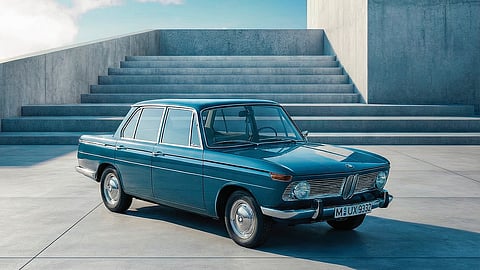
Around the same time, my chacha drove a red BMW Neue Klasse. Four cylinders, yes, but still a BMW when the badge carried a certain quiet authority.
No one discussed horsepower figures. Sharma-ji didn’t ask how fast it was. Gupta-ji didn’t care about acceleration.
Uncle Harjaspreet Singh would simply nod and say, “German car. Good metal.”
Masculinity then wasn’t about performance. It was about competence. You drove what worked. You fixed what broke. And you didn’t complain.
Back then, a V8 didn’t make you macho. It made you prepared and permanently alert to petrol prices, even before petrol prices were a thing.
By the time I was born, masculinity had settled into something far more recognisable: the four-door sedan.
My father’s Toyota Corona Mark II comes to mind instantly. Solid. Predictable. Dependable.
My mamaji’s BMW E12 5-Series was elegant, but still very much a family car. Aspirational, yes, but never impractical.
Across our community, each garage told the same story: BMW 5 Series, Mercedes E-Class, Peugeot 508, Mitsubishi Galant and Lancer, Nissan Bluebird and Sunny, Honda Accord and Civic, Toyota Corona and Corolla, Volvo 740 and 940.
Sports cars were so rare that if someone had one, news travelled faster through the community than any car ever did on the road.Conversations followed a predictable pattern:
"Very nice car, but speed breaker problem?"
"Petrol is also very expensive-premium petrol only?"
"Service centre nearby or you will cry later?"
Masculinity, at this stage, had a very clear brief: four doors, a generous boot, and absolutely no interest in lap times.
I recently came across old community magazines from the 90s. One section was called “Autobahn.”
Despite the name, it wasn’t about speed. It was about being sensible.
Article after article focused on fuel efficiency, resale value, maintenance costs, and long-term ownership.
Nobody romanticised cars. Nobody talked about passion projects. If a car could survive Bangkok traffic, questionable fuel, and the occasional skipped service, it earned respect.
SUVs hadn’t entered the chat yet, so there was no talk of rugged lifestyles.
The real flex was simple: your car didn’t break down on the way to a wedding, and you didn’t arrive late with an explanation nobody believed.
Masculinity wasn’t performative. It was preventative.
Then came our turn. We didn’t buy cars. We inherited them, along with strict instructions, moral responsibility, and the familiar line, “Drive slowly, okay?”
This is where cars stopped being purely functional and started becoming personal.
We didn’t have budgets for engines or suspension, so we began where we could—sound systems.
Shops near Chiang Kong became weekend hangouts. Panasonic speakers. Tweeters. Amplifiers. Enough bass to feel rebellious, but not enough to require a family meeting.
Some of us went further. Slammed Mitsubishi Lancers. Chrome rims on Hyundai Elantras. Loud exhausts that sounded faster than the car actually was.
Fake Brabus and Lorinser rims on dad’s Mercedes. BBS wheels on the BMW 3-Series. Honda Accords on hydraulic suspension—up, down, up again—simply because someone figured out how.
Women were very much part of this phase too, often with better taste. Many cared less about noise and more about how the car felt. Comfort. Smoothness. Sound quality.
Some of the cleanest builds belonged to women who never once called themselves “car people”, yet somehow knew exactly what they wanted.
Sports cars were still rare. But for the first time, the cars felt like ours.
Street racing became aspirational overnight. Crews formed. Late nights happened.
Anyone who grew up in Bangkok in the early 2000s knows exactly which roads, which cars, and which stories, even if we all politely pretend otherwise now.
To be fair, some people did have coupes. We didn’t have actual GTRs or Evo VIs in large numbers—Thai taxes made sure of that—but we had close enough.
Decked-out Nissan 200SXs. Heavily modified Lancers playing dress-up as Evos. Enough boost. Enough noise.
Enough confidence to genuinely believe we were in a movie, right until someone’s uncle recognised the car at the next family function.
Why didn’t we have proper sports cars en masse? Thailand’s tax structure answered that brutally.
Anything over 220 horsepower or above a 3.0-litre six-cylinder attracted eye-watering penalties.
So, we modified what we had. Corona. Cefiro. Accord.
Masculinity flirted with danger during this phase, but responsibility always sat in the passenger seat, usually sounding suspiciously like our father’s voice, reminding us what time dinner was.
Then adulthood arrived. Quietly. Inevitably.
Sports cars began appearing in our community, but cautiously. If someone bought one, it was news. Group chats buzzed. Family WhatsApp chats lit up. “Did you hear?”
But something else shifted. Speed stopped being the main talking point. Presence became more important.
SUVs took centre stage, such as the Porsche Cayenne, BMW X5, and Range Rover.
Luxury sedans, like an S-Class, 7-Series, or Maybach, redefined success.
VIP culture grew quietly—tasteful rims, immaculate paintwork, obsessive detailing. Power without noise.
And yes, some people made it big with Bentley, Ferrari, Porsche, Lamborghini, Aston Martin, or Maserati. Not to announce anything, but because they could.
And because car lovers, when they arrive, tend to celebrate privately.
Masculinity didn’t disappear. It simply became more comfortable.
Here’s the thread that runs through all of this: the cars changed, but the thinking did not.
Our community still values sensibility. Still values comfort. Still values long-term thinking.
If you want one dependable car, the Toyota Camry remains terrifyingly sensible.
If you want space and comfort, the Alphard continues to define the category.
If you want luxury, the S-Class and 7-Series still anchor the conversation.
If you want an SUV, the CR-V remains the answer nobody argues with, not even the guy who wanted something flashier.
Different decades. Same instincts.
EVs and Chinese brands have quietly rewritten the rules again.
Friends now say things like, “BMW is very nice, but it’s not four times better than a BYD or a Tesla just because it costs four times more.”
And honestly, they’re not wrong.
A Cayenne or Alphard is wonderful, but Zeekr and Denza are doing alarmingly similar things with more screens and fewer service visits.
Cars have gone from “listen to the engine” to “wait, why is the screen rebooting?”
Cars are becoming gadgets. Upgradeable. Replaceable. Rational.
And once again, notice the pattern—practicality still wins.
Thailand has one of the wildest car cultures in the world. Auto salons. 500-horsepower pickup trucks.
The Honda City and Toyota Yaris are capable of speeds no one should admit to. Engine swaps that defy logic.
Thai-Indians, largely, stayed out of it. Not because we couldn’t, but because we wouldn’t.
Different priorities. Different risks. Different definitions of success.
Thailand went racing. We went refinancing.
Cars once defined masculinity loudly. Today, they do it quietly.
Our community never chased excess. We chased stability, respect, and thoughtful self-expression.
From Kingswoods to Coronas, from hand-me-down Accords to Alphards, from mechanical drama to electric calm—the tools changed, but the values didn’t.
We didn’t lose masculinity. We refined it.
And in a world that keeps getting louder, that quiet confidence might just be our most enduring trait.