
- HOME
- TRENDING
- PEOPLE
- COMMUNITY
- LIFESTYLE
- OUR PUBLICATIONSOUR PUBLICATIONS
- MASALA RECOMMENDS
- MASALAWEDS
By Ishaani Budhraja
I work in the wedding world, which means I meet people in love every single day. Being the emotional fool that I am, I always find myself touched by their meet-cute stories and the way they navigate life together.
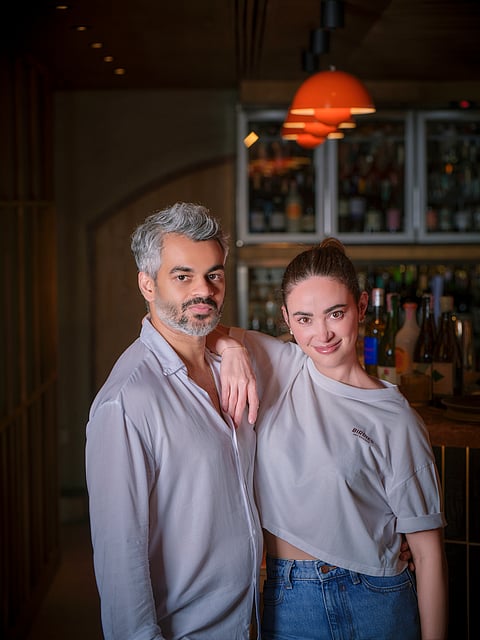
But meeting Ratish Sachathamakul and Jennifer Evans was different. This felt like a match made in heaven, two people crossing paths at a time when both were rebuilding, figuring things out, and looking for solid ground. I honestly believe Jen was sent to Ratish by his parents. I have rarely seen a better fit.
They are completely infatuated with each other. Sitting across from them, the room just felt lighter. Jen has a presence that is quite literally angelic, so much so that a single white feather drifted down and landed right in front of her, as if on cue, while we were talking.
Ratish brings this incredible warmth and a quiet depth; every word he shared felt like something I was meant to hear. Would it sound almost crazy to say that it felt more like a spiritual moment where you connect with someone’s energy than an interview?
But beneath the obvious affection is a story about two people who had already lived through their own difficult chapters before finding each other. It is a story of resilience, pivoting through grief, learning when to let go, and ultimately building a shared life from the ground up.
To understand Ratish today as a grounded entrepreneur, partner and father, you have to understand the journey that forged him.
"I feel like I was one person before and I'm someone else now," Ratish told me. "I used to have a very young mindset, partying a lot, being a believer in just enjoying life. But I always knew, even from the age of 13 or 14, that I wanted to create experiences for people in F&B. I loved going to restaurants and being out, and I knew that’s what I wanted to give back."
Born into a prominent Thai-Indian family with roots in manufacturing and property, his path back home felt almost inevitable. Ratish finished his entrepreneurship degree at The Royal Melbourne Institute of Technology (RMIT), and went on to work through the ranks in Melbourne’s hospitality industry for five years, eventually managing the iconic Melbourne Supper Club.
A speaker at a seminar changed his perspective. The speaker argued that returning home right away gives you nearly a decade of real-world, ground-level experience that working elsewhere just cannot match.
That advice brought Ratish back to Thailand. One of his first major trials was managing the two-year construction of the Novotel Phuket Kamala Beach, a massive learning curve that taught him how to handle heavy obstacles and build independently.
While he respected his father’s manufacturing legacy and considered him a lifelong mentor, Ratish knew his heart was in hospitality. Pitching plan after plan to his father until he proved his concepts were solid, he broke out into Bangkok’s food scene.
He became an early investor in Tropic City, in Larder, partnered on Aesop’s, launched the street food favourite Cholos, and opened Mezcal in Sathorn.
For a while, Ratish was doing what he had always imagined: creating experiences for people. Then, in 2021, everything changed.

A devastating accident took both of his parents. In an instant, his world shattered.
"For my whole life, I was lucky enough to be cared for by a family of means. Then, for the first time, I had the fear that there was no one else to look up to for answers," he shared. "It was just me and my siblings."
With his brother and sister based in Australia, Ratish stepped up to handle the immense weight left behind, but the process of rebuilding was very much a collective family effort. Together, they worked through the challenges, solved problems as they arose and began building things back up.
The first year was a blur of court dates, land departments, and keeping family manufacturing businesses running while accounts were frozen. From the second year onwards, he and his siblings worked together to consolidate the family assets, sell their plant in India, and manage to sell industrial land in Thailand above market price during a slow economy.
That period fundamentally altered how he viewed life. Navigating long-standing OCD and anxiety, Ratish turned toward Stoic philosophy and mindfulness to process the weight.
"Marcus Aurelius once wrote, 'Water wouldn't sound so beautiful without the rocks in the way'. Instead of asking 'Why is this happening to me?' I started questioning the hardships that made me who I am. If you remove every hardship, you might also remove the very experiences that made you extraordinary."
He also pointed me toward a Harvard and Massachusetts General Hospital study on neuroplasticity, showing how eight weeks of mindfulness meditation physically alters grey matter in the brain.
"I’m an overthinker, and sitting still for even two minutes is hard for me. But understanding that shifting your thoughts physically changes how you experience the world gave me a tangible way forward."
It was during this period of rebuilding that another person entered his life—someone who, in many ways, had already learned her own lessons about resilience, reinvention and knowing when to walk away.
If Ratish brings strategic depth and Stoic calm to their world, Jen brings operational sharpness, raw honesty and heart. Growing up in Thailand, her relationship with food was always grounded in family warmth.
"Food was the biggest thing in our house," she smiled. "My dad would cook up a feast every Saturday. Food was never a demon, it was comfort and celebration."
Her journey led her through Le Cordon Bleu and even a stint managing operations in Australia's horse racing industry, before a whirlwind turn on the reality TV show My Kitchen Rules Australia (2010–present), which she ultimately won.
But reality TV came with a heavy cost. Edited into a villain character, she faced intense online bullying.
"You’re doing 10 hour interviews on three hours of sleep, being fed lines to repeat. I went on the show purely because I loved cooking."
Moving past the noise, she took over a restaurant in Sydney’s business district. The venue was packed every lunch, but sky-high Australian labour costs and limited operating hours meant they were barely breaking even.
Knowing when to walk away, she closed the venue, a hard lesson in business reality that would prove invaluable later on.
As her mother grew older, Jen wanted to be closer and moved back to Bangkok to care for her. That was when her path crossed with Ratish’s.
"We actually met online about four years ago," Ratish told me. "From our very first conversation, I felt this immediate comfort, like we had known each other forever."
Their story, however, apparently started even earlier. Before they officially met, Jen, and her sons Harlow and Hudson had visited Cholos as a family to try a new Mexican restaurant in Bangkok.
Ratish had also spoken to Jen on the phone when she called one of his restaurants to make a reservation, without either of them knowing who the other was.
When they finally met in person, Ratish was still navigating the heavy grief of losing his parents, and his health had taken a backseat.
"He was struggling when I met him," Jen recalled quietly. "His judgment was impaired, his health was neglected. But he was so kind. It would have been unfair to judge him at his lowest. I believed that if we sorted out the basics, waking up early, eating well, staying active, and setting healthy boundaries, everything else would fall into place."
There is something telling about the way Jen describes that period. She did not arrive trying to fix Ratish. She saw where he was, understood what he had been through, and helped him find his way back to the basics.
And, naturally, that partnership soon extended beyond their personal lives. Bringing her deep background in kitchen management and front-of-house operations, Jen stepped in to help streamline Cholos.
"Jen restructured the kitchen, raised our quality standards, and made the hard calls to close underperforming satellite branches that were draining us," Ratish credited. "She completely turned the operation around."
The two were beginning to understand what they could build together—and, equally importantly, what they were willing to let go of.
Bangkok’s dining scene moves fast, fuelled by fleeting trends and short attention spans. Their joint venture, Birdies, taught them crucial lessons about market timing.
While Birdies built a dedicated following among expats and travellers, attracting local Thai diners proved difficult.
"People think closing a restaurant means you failed," Jen explained. "It’s not a failure, it’s a stepping stone. The backend of F&B is tedious and complicated. With Birdies, we had an amazing product, but Bangkok’s market got saturated, and local diners wanted clear value for money."
As their family grew, their priorities were also shifting. The higher-end dining market was increasingly saturated and competitive, while running a full-service restaurant required significant hands-on time, particularly evenings and weekends.
They wanted to focus on concepts that could still reflect their standards and creativity while being more scalable, while also being present for their children and the small moments they did not want to miss.
"Everyone thought Birdies was just a casual fried chicken joint, missing the elevated culinary work we were doing," Ratish added. "We realized timing and clear communication are everything."
Rather than seeing the experience as a defeat, they took the lessons with them. Those lessons became the foundation for FRICKIN’ Fried Chicken, a brand conceptualised and run entirely by Jen.
The food concept and menu were fully conceptualised by Jen, including the recipes, kitchen operations, execution standards and the overall way the kitchen runs. Her culinary and operational experience shaped the food side of the concept, while the two worked together on the marketing and branding.
Ratish took the lead on business development, systemisation, technology integration and growth strategy across the business.
Built around sharp operational systems and consistent quality, it gives the market a straightforward, high-value product built to scale.
When I asked them how they survive an industry obsessed with trends, their answer was simple: stay authentic.
"I don't believe in food trends," Jen said candidly. "They have no longevity. We stick to what we know: good product, great service, and real quality."
"Systemisation is everything now," Ratish emphasised. "You have to build a model that scales without sacrificing quality, so you aren't trapped in day-to-day operations forever. Know who you are and stick to your foundation."
Perhaps that philosophy says as much about their relationship as it does their businesses. Both have learnt that not everything needs to be held onto.
Sometimes, resilience is about knowing what to build, what to change and what to leave behind. Sitting with them today, it is clear that success for Ratish and Jennifer is no longer defined by business expansion or public recognition.
Having walked through deep personal loss and heavy trials, their world has turned inward toward what truly matters.
For Jen, peace comes from staying true to her values.
"As I get older, success looks completely different. It’s having time for family, setting firm boundaries, staying true to your integrity, being content, and helping people. That is the biggest success."
For Ratish, life with Jen and their sons, Harlow, Hudson and Haylen, is the realisation of everything he ever wanted.
"I consider my life now a complete success," he told me smilingly. "Work is not everything. Having time, protecting your energy, and prioritising your family is what matters."
One of the sweetest things Ratish shared was a daily habit Jen brought into his life: anchoring themselves in small, quiet pleasures.
"Making our own coffee together in the morning, having breakfast as a family, taking time for afternoon tea even when we're busy, or planning our next trip together," he reflected. "Giving those little moments real importance reminds us every day how lucky we are."
Ratish and Jennifer showed me that the strongest partnerships aren't built on business success alone. They are built when two people help each other heal, grow, and appreciate the present moment.
They have both experienced what it means to have life change in ways they never expected, and both have had to learn how to begin again. Standing alongside each other through life's hardest storms, they have built a life defined not just by what they do, but by how deeply they care for one another.
Maybe that is why, sitting across from them, the whole room felt lighter.