
- HOME
- TRENDING
- PEOPLE
- COMMUNITY
- LIFESTYLE
- OUR PUBLICATIONSOUR PUBLICATIONS
- MASALA RECOMMENDS
- MASALAWEDS
In the span of only a few years, Swanti Sethi went from living life at full throttle—working relentlessly, creating endlessly, and playing just as hard—to confronting a near-death illness that would force her to stop altogether.
What followed was not only a fight for survival but a reckoning with self, identity, and purpose. It was a journey that would force her to unlearn, rebuild, and ultimately redefine what healing truly meant.
Some stories disarm you before you even realise it. You find yourself scrambling for something to anchor you mentally, bracing yourself before surrendering to the gravity of what’s unfolding. I found myself in that very position, sitting across from Swanti—eyes locked, brows furrowed, hypnotised by the cadence of her voice as she began to unravel the defining chapters of her life.
This wasn’t merely a tale of resilience or reinvention. It was a deeply human story about collapse, awareness, and becoming.
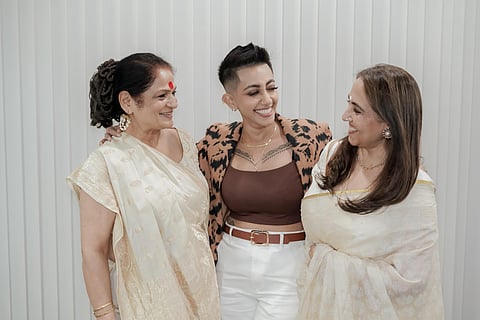
Dressed in all white, seated cross-legged with a relaxed but attentive posture, Swanti radiated an energy that was grounding yet unmistakably powerful. A therapeutic sound healer, mindful doodle art facilitator, and co-creator of a nature-based health retreat, she is someone who speaks with clarity earned through lived experience.

Born and raised in a traditional Punjabi family in Bangkok, Swanti quickly learned that she did not fit neatly into the expectations set before her.
“There were a lot of challenges growing up that led to unhealthy behaviour as a child,” she explains. “I stood out in my family, and because of that, I was ostracised by the wider community. Once I was given that label, I leaned into it even more.”
Being marked as “different” shaped her early relationship with identity and her path to evolving. By the time she reached adulthood, Swanti was determined to leave Bangkok behind. At 18, she moved to Los Angeles, following what appeared to be a natural progression.
Her father had been a fashion designer for over four decades, and fashion school offered both an escape and a sense of legitimacy—a reason to leave that could not be questioned. But Los Angeles, she learned quickly, was not forgiving.
“It’s dangerous ground,” she says. “LA will swallow you whole and spit you back out. I didn’t know who I was. There was no sense of self.”
Immersed in glamour, excess, and newfound freedom, she found herself caught between exhilaration and disorientation. Fashion itself failed to fully capture her attention, but the world surrounding it did.
She became transfixed by the backstage ecosystem, particularly the makeup artists, watching transformation unfold in real time. The artistry, the immediacy, the ability to shape identity visually sparked something she had never felt before.
“That was where I felt most like me—being busy, being in control, creating. Work was my escape, my safe space, my everything.”
Returning to Bangkok in her early 20s, Swanti briefly worked within her father’s factory, attempting to apply what she had learned abroad. The experience was challenging. Navigating hierarchy, gender politics, and ageism proved overwhelming.
“I was put in a position where I was giving instructions to older men,” she says, laughing. “That didn’t go down too well.”
Yet those years would quietly lay the groundwork for resilience and leadership. Around the same time, a former high school psychology teacher and yearbook advisor, now experimenting with conceptual photography, rekindled her creative spark.
His work was bold, avant-garde, and narrative-driven.
“I was so blown away,” she recalls. “Something woke up inside me. I thought, wait a second, this is actually what I want to do.”
With clarity and humility, she thanked her father for the opportunities he had given her and committed fully to carving her own path. She trained as a makeup artist and moved to India to deepen her experience in the bridal world, working closely with industry leaders and immersing herself in technique, discipline, and cultural nuance.
Around this time, fate intervened. The teacher who had once inspired her reached out, impressed by her growth and eager to collaborate. What followed was a creative partnership that would push her beyond her perceived limits.
“We used to butt heads back in school,” she admits. “He never thought I’d amount to much, and honestly, back then, I didn’t apply myself.”
“But working together later in life, he challenged me in ways I had never experienced. He took me to levels I didn’t know existed.”
Their collaboration led to international projects and travel, reinforcing her confidence and solidifying her place within the creative industry. Her hunger for learning eventually took her to London, where she enrolled at the Academy of Freelance Makeup.
There, she was introduced to high-level productions, special effects, and the deeper realms of avant-garde artistry. To sustain herself as a freelancer, Swanti diversified—working as a wedding planner, teaching aspiring artists, and mentoring young creatives.
What began as a financial necessity soon became another layer of understanding, allowing her to see both sides of the business, creative and commercial.
Her career flourished. She built her own makeup team, contributed to international fashion shows, advertising campaigns, and editorial shoots, opened a photography and videography studio, and worked toward launching Creative Labs Academy—a space where creatives could learn, collaborate, and grow.
At this stage of her life, Swanti was unstoppable. She worked up to 19 hours a day, fuelled by ambition, adrenaline, and a relentless desire to prove herself.
“Those were the days when I lived on coffee… and lots of beer,” she laughs.
Sleep, she admits, became a stranger. What looked like momentum from the outside was, in hindsight, a form of self-erasure. At the time, exhaustion felt like a badge of honour; only later did she recognise it as her body asking to be heard.
Seven years ago, Swanti was diagnosed with lupus—an autoimmune disease in which the immune system attacks healthy tissue. For someone whose identity was rooted in productivity, control, and momentum, the diagnosis was devastating.
“That was where I felt most like me, being busy, being in control, creating,” she explains.
“Work was my escape, my safe space, my everything.”
When illness forced her to stop, everything collapsed at once. A failing marriage, an inability to work, and a body in constant pain pushed her into unfamiliar territory. Blood clots left her bedridden for months. Coping mechanisms were stripped away.
“When I got sick, everything just stopped,” she says quietly. “It killed my soul.” All of a sudden, she was getting divorced, unable to work, and bedridden after developing six blood clots in her right leg. She thought she was just overworked, even though there were symptoms throughout that year—never imagining the ramifications would be so severe.
What followed was an intense period of introspection. Years of unprocessed trauma, anger, and self-protection surfaced.
“I realised I was always ready to fight,” she reflects. “I had built armour around myself.”
Transitioning out of an unhealthy marriage, unable to walk for six months, no longer able to work, no more drinking, no more smoking—all of her coping mechanisms disappeared, leaving her to deal with herself, her emotions, her mind, and her broken body. This is where her spiritual awakening began.
Various outlets of support existed in her life since adolescence, though rarely discussed openly within her community.
It may not have solved the core issues; still, she credits her parents, particularly her mother, for seeking help wherever possible, including holistic practices that complemented conventional care.
As Swanti began to examine her habits more closely, a critical realisation emerged.
“The body is a reflection of the internal emotional and mental state,” she says. “I understood why my body was failing me. It wasn’t just stress or work—it was how I spoke to myself.”
Then came the pandemic.
Seeking safety, she relocated to Koh Samui, hoping distance and stillness would aid her recovery. Instead, isolation, relationship strain, and unresolved patterns triggered another decline.
Despite professional success, including working with one of her biggest clients, Netflix, her health deteriorated rapidly.
In January 2023, during a routine check-up in Bangkok, she received devastating news: Stage Two kidney disease, progressing aggressively.
Returning to Samui, emotional fallout and relationship breakdown compounded the physical strain.
Weighing just 45 kilos, weak and disoriented, Swanti eventually returned to Bangkok.
Unbeknownst to her, her parents had sought guidance from a monk, who delivered a stark message: “Bring your daughter home. The ship has sunk.”
Doctors monitored her declining kidney function, warning that dialysis, or worse, was imminent. A transplant was not an option.
With conventional medicine offering little hope, her family turned to a temple specialising in holistic care for terminal patients.
What followed would become the defining moment of her life.
“It was so sudden. I was being driven to the temple, and I was busy texting away to my friends about my return, and at a particular moment, a weight had lifted off me,” she shared in relief.
“It felt as if the pain disappeared. I looked up, and we had passed the temple entrance. I was instructed to stay in the facility for 30 days, get into the program, and was urged not to leave until it was all completed. Keep in mind, my health was up-and-down, and I kept relying on weed (now, for medicinal purposes) to subdue whatever pain there was.”
However, on day 25 of 30, Swanti experienced a medical emergency so severe that survival seemed unlikely.
Undeterred, she decided to smoke marijuana to ease the pain before the daily evening meditation, which was allowed within the temple premises for medical purposes only.
But this time, even inhaling the smoke had become troublesome, and violent coughs ensued, followed by vomiting. The fear had kicked in.
“My mother told me I was turning blue. I couldn’t breathe, but my mind was aware of my surroundings.
In our peripherals, we noticed a lady who usually works in the kitchen who would never venture off near the dorms. Apart from my mother and me, she was the only visible soul. And she also happened to have a mobile phone on hand, whereas participants of the program had no access to theirs. If she hadn’t been there, I would have died on the spot.”
“Everything went quiet,” she recalls. “It was pitch black, but peaceful. I wasn’t scared. I felt ready.”
In that stillness, she had visions—not of her past—but of herself in a healing space connected to land, nature, and service.
That image, she believes, pulled her back.
It would foreshadow the physical manifestation and future expression of Consc—a nature retreat that is the culmination of her healing journey, in turn serving others with the same reverence.
“I took a breath, and I was back. I looked at my mother and asked her what happened.
She said she thought I died, that she had lost me. I had a near-death experience,” Swanti delivered in a solemn voice.
Eighty days later, she returned to modern medicine, carrying not only survival, but clarity.
After discovering her kidney had progressed to Stage 5, her mother’s relentless approach to saving her daughter led her to seek guidance from a spiritual healer.
The spiritual healer prescribed a strict 180-day regimen involving meditation, essential oils, self-dialogue, and unwavering consistency.
“I was sceptical,” she admits. “But I committed.”
She was solely focused on this healing regimen.
“I’d go to the hospital every day and do what I was instructed. I was also told to speak to my medication because I had so much anger toward it. She told me to be kind to it and kiss the medicine. I’m thinking, okay, this is weird. But fine, I’ll do it, let’s just try it her way. I was diligent with the new habits.”
Four months in, something shifted.
“I realised this was radical self-love. After completing the 180-day regimen, I went back to the doctors for a check-up. The doctors were astonished. My kidneys were fine. I should have been on dialysis, should have gotten a transplant; my kidneys were on the way out. How have I gotten my kidneys back to normal, even better than a normally healthy person? At that point, I became a full believer in this process of healing.”
At the end of the program, doctors were stunned.
Her kidneys had stabilised—stronger than expected. Against every prognosis, she was thriving.
While holistic practices supported her inner healing, modern medicine remained central to stabilising her body, with medication adjusted only as doctors observed clear, measurable improvement.
Throughout the process of healing, Swanti spoke to her spiritual healer, Dimple Anil—a critical component in this journey—about the visions on that fateful day.
“She came to visit me there, and she said my visions were right,” Swanti reveals.
“She told me this space would be a place of healing from an interaction they had seven years ago. I forgot that the same spiritual guide my mother has been in contact with for so many reasons spoke of this reality so long ago.”
Swanti had rewired her relationship with herself from the core.
From the brink of death, she found her purpose.
Today, she has taken the reins at Prem & Yoga Ayurveda Center as the resident sound healer, credited to her sound healing teacher Yogshri Sivananda.
The ‘new’ holistic way of living was in front of her the entire time.
This particular space existed for 16 years, founded by her mother, and it was the same space where her mother brought her for support across different stages of Swanti’s life.
This became the ground where her personal healing transitioned to guiding others in wellness.
Eventually, this would lead her to her larger vision of establishing Consc.
Moreover, she incorporated mindful doodle art, learned from her affectionately known soul-sister, Sapna Sabharwal.
It not only helped Swanti break out of her perfectionist mindset, but it became a powerful tool to assist others in reconnecting with themselves.
With parting words, Swanti ended our conversation with a message to all.
“To bring the feeling of happiness back in, you have the power to shift the energy.
You can acknowledge your sadness and pain, but you can consciously choose to become a positive reinforcement in your space.
Once people can understand the responsibilities to themselves, they will understand the power they have.
What reflects on the outside is just a show. The true journey is within.
Everyone has a purpose, and it usually has to do with humanity. We’re all here to serve one another in our own way.
There is always a solution; you have to find what fits you. And you won’t find it unless you try. Consistency is key, and only you can put in the work.”