
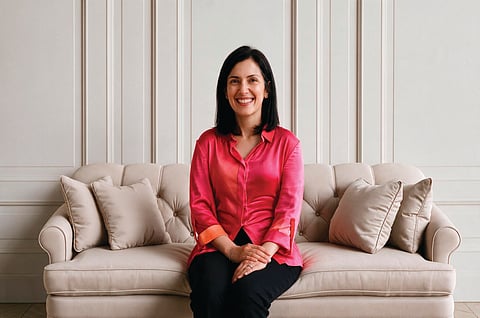
Dr. Narisha Chawla Is Transforming Paediatric Dentistry
There are people who leave an impression because of what they’ve accomplished. Then, there are those who leave one because of how they make you feel.
Dr. Narisha Chawla somehow manages to do both, although I suspect she’d be the first to downplay both, too.
Before we met, I knew the facts. She was a paediatric dentist, an educator, a business owner, and someone whose work had taken her from remote communities in Australia to some of the most challenging situations imaginable.
I expected someone driven by ambition. Instead, I met someone driven by compassion.
What started as an interview quickly turned into an easy conversation, punctuated by unexpected laughs and the occasional detour into stories that had nothing to do with my list of questions.
She’ll happily tell you she’s not funny, but I spent most of the afternoon disagreeing. If the way she made me feel is anything to go by, it’s easy to understand why her young patients walk into her clinic feeling safe.
As our conversation unfolded, I realised dentistry is simply the medium through which she makes that difference. At its heart, her work isn’t just about treating teeth; it’s about building trust, easing fear, and making children feel safe.
And perhaps that’s what makes her story so compelling.
Tell me a little bit about yourself. Who is Narisha Chawla?
On paper, I am a paediatric dentist, a co-owner of a specialist private practice, a consultant at the Royal Children’s Hospital Melbourne, and an educator.
One of the most rewarding parts of my job is training qualified dentists who want to specialise in paediatric dentistry. I’m also fortunate to contribute to the Melbourne Dental School as a member of the External Advisory Board and as an External Examiner.
Beyond the clinical gown, I’m a granddaughter, daughter, sister, wife, and mother. Above all, I’m someone who feels incredibly fortunate to be surrounded by a big, loud, and deeply supportive family.
You work with anxious children and children on the autism spectrum. What drew you to this niche?
Growing up, I watched my parents and my grandmother dedicate their lives to helping people in every way possible, big and small.
They never lectured me about kindness; they simply lived it. They taught me that the true measure of a person is how we treat the most vulnerable.
This philosophy is the heartbeat of my career. In addition to my rewarding work within the public healthcare system, it is the driving force behind the private practice that I co-founded with two wonderful colleagues.
Children with different needs, whether it is neurodivergence or complex medical issues, often face difficulties accessing healthcare, including dental care.
Our core mission is simple but stubborn: to remove the barrier and fill this gap. That is what drew me to this niche.
We firmly believe that every child deserves access to specialised and dignified dental care. It shouldn’t be a luxury; it should be a fundamental right.
I imagine it takes a high level of empathy to work with anxious individuals. How do you protect your own energy or desensitise yourself when working with kids?
I actually hope I never become desensitised!
Empathy isn’t a liability in paediatric dentistry; it’s the most important tool in my kit. If I stop feeling what a frightened four-year-old is feeling, I lose the ability to connect with them.
And in my job, connection is everything.
People think paediatric dentistry is just about teeth, but it’s actually a mix of science, behaviour management, and psychology.
Our practice is mainly referral-based, which means we see the most anxious and complex of children, and their parents usually walk in carrying a load of guilt or worry.
I try to put myself in their shoes immediately.
Yes, some days are emotionally exhausting, but the energy refill comes naturally because I genuinely love what I do.
There is nothing quite like winning over a kid who swore they wouldn’t open their mouth. Talk about simple joys!
Throughout your career, you’ve volunteered in extraordinary settings—from providing dental care in remote Australia with the Royal Flying Doctor Service to assisting with victim identification after the Phuket tsunami. How have these experiences shaped you?
They completely recalibrated my perspective on what truly matters.
The Royal Flying Doctor Service allowed me to combine my love of flying with my mission to reach people who have the least access to care.
Operating in the middle of the Australian outback with limited resources forces you to be incredibly resourceful!
The Phuket tsunami happened right at the beginning of my career, before I had even clocked into my first proper job.
When a tragedy of that magnitude happens on your own doorstep, you don’t think about yourself; you just show up.
Helping grieving families find a sliver of closure was an honour.
Every time I volunteer, whether in Thailand or abroad, I walk away with the exact same feeling. I have received far more from these communities than I could ever give them.
Your profession is centred around caring for others. How do you care for yourself? Does flying still hold a special place for you?
Flying is magic.
Up in the air, the noise of the world drops away, and there’s a profound sense of clarity.
I haven’t flown in years, but it’s a passion I definitely plan to return to when life slows down a fraction.
These days, my self-care keeps me on the ground in a different way.
I’m currently training hard to earn my black belt in Taekwondo by 2030.
It requires intense focus and physical resilience, which perfectly counteracts the quiet, meticulous nature of dental work.
It also keeps me incredibly humble because I train alongside my own kids—who are significantly faster, much more flexible, and take great joy in out-kicking their mother!
How has motherhood influenced the way you approach your own ambitions?
Motherhood changes your rhythm but not your drive.
It has certainly given me a deeper purpose.
More than anything, being a mother has made me want to show my kids that you can love your family fiercely while still chasing meaningful goals.
My ambitions are no longer just about me, but the mark I leave for my children.
It has also taught me that your ambitions don’t need to be big or fancy to make an impact.
Success is not about doing more and more.
At the end of the day, my ultimate goal is to ensure that my children and people dearest to me feel that I always have time for them.
Time is something that cannot be bought, and it is the most valuable, irreplaceable thing I can give to the people I love.

What, according to you, has been the proudest moment in your life and/or career?
Professionally, I feel incredibly grateful for the trust placed in me by families, colleagues, and the community.
Caring for children, teaching future paediatric specialists, and contributing to dental education through the Melbourne Dental School are all privileges I never take for granted.
The moments that really matter to me, however, aren’t the ones that come with titles or recognition.
They are the little victories of seeing confidence develop in a child who was once terrified, a parent leaving the clinic feeling relieved, or hearing a university student repeat your advice.
Personally, my proudest moments are happening right now in real time.
Trying to follow in the footsteps of my parents and grandmother by raising my own children to be kind, empathetic human beings is the hardest—and best—job I’ve ever had.
Seeing them carry forward the values of compassion that have been passed down is the greatest reward I could ever ask for.
If they turn out good and kind, I’ll know I did my job.
Is there something that you feel has shaped your approach to working with patients—perhaps growing up in Thailand, your upbringing, or specific philosophies?
Absolutely!
My entire philosophy is built on the foundation laid by my parents and the collective spirit of my beautiful extended family.
One of my most valuable core memories is being on a bus with multiple generations of the family, the eldest being my grandmother and her sisters, heading to a remote community in Thailand to make donations.
The bus would always be filled with music, people singing along with the dholki (and a big tablespoon for good measure), and the smell of freshly made chai and roti.
This was our extended family’s idea of a fun weekend—spending quality time together while helping others.
I grew up watching them give selflessly to anyone who needed a helping hand.
I like to think that shaped my approach to work: having fun and making a difference at the same time.
You balance many roles—clinician, educator, business owner, mother, and volunteer. How do you manage it all?
I’ve learned that perfect balance is a myth.
It’s not about doing everything equally; it’s about giving each thing your full attention at the right moment.
When I’m with a patient, I’m 100 percent a dentist.
When I’m at home, I’m 100 percent a mother.
I have my husband as the co-captain in the madness.
He is an incredible dad and always ready to tackle the kids, literally and figuratively!
A big part of staying anchored is remembering where you came from and the people who helped you along the way.
Both Thai and Indian cultures place a beautiful emphasis on gratitude, respect, and remembering the hands that supported you.
To me, that means never forgetting the communities, mentors, and loved ones who have contributed to my journey.
What’s next for you? What are your goals for yourself?
My next project is incredibly close to my heart.
I’m currently completing my Train the Trainer certification so that I can become a qualified CPR instructor.
This became especially meaningful after someone very close to me survived a major cardiac arrest because a trained CPR provider happened to be nearby.
It made me realise how powerful a simple skill can be.
After that scare, I wanted everyone in my immediate circle to be trained in CPR.
However, I quickly realised there were very few places in Bangkok offering these courses to the general public, and the options that did exist were simply unaffordable to most.
Having renewed my own CPR certification every year for the past two decades, it felt like the natural next step to become a trainer myself.
Once qualified, I hope to run free CPR courses in Bangkok in both Thai and English, making them accessible to as many people as possible—parents, children, drivers, nanny-helpers, and security guards.
Everyone should have the power to save a life.