
- HOME
- TRENDING
- PEOPLE
- COMMUNITY
- LIFESTYLE
- OUR PUBLICATIONSOUR PUBLICATIONS
- MASALA RECOMMENDS
- MASALAWEDS
We debate composting, carbon footprints, and biodegradable materials. We install solar panels in our homes, boycott fast fashion, and plant memorial trees. Yet centuries before sustainability became a moral accessory, the Parsi Zoroastrian community had already asked a far more uncomfortable question: what does it mean to be environmentally responsible in death?
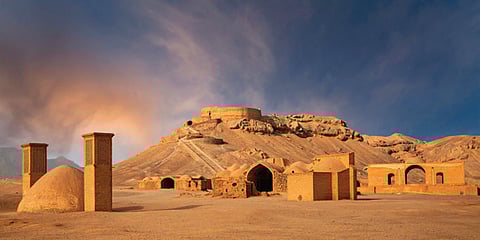
The answer was Dokhmenashini—the ancient funerary practice in which the body is placed atop a dokhma, also known as a Tower of Silence. Open to the sky and sunlight as birds return the body to nature swiftly. The bones, once purified by time and light, settle into an ossuary.
At first glance, it is unsettling. There are no ashes. No embalming. No casket lowered into the earth. Instead, there is sunlight, stone, and air—the quiet act of nature doing what nature has always done.
But to understand this ritual, one must understand the spiritual beliefs of Zoroastrianism. In this tradition, the elements of earth, fire, and water are sacred; they are not resources but divine creations. And a dead body, once the spirit has left it, becomes biological matter. Decay is natural.

So, the Parsis chose a solution that sounds radical even today. The body is returned to the open sky so that decomposition occurs without polluting soil, fire, or water. The sun purifies, and birds feed on the bodily remains to complete the cycle.
It may seem brutal, but in essence it is merely biology. Dokhmenashini refuses the illusion of permanence. Modern death rituals often attempt to freeze the body in time, embalmed and sealed in a casket, protected from the very earth that created it.
But this ritual does something braver. It acknowledges that the body was always on loan.
Long before “green burial” became a concept, this practice had already embraced ecological ethics. No timber is burned in cremation. No ashes contaminate rivers. No embalming chemicals seep into soil, and no land is claimed indefinitely. It is a closed loop.
This idea is not isolated. Tibetan Vajrayana Buddhists practice sky burials that emphasise impermanence. Indigenous traditions across the world return the body to the forest, sea, or plain. Even contemporary green burial movements echo the same intention: to let the ecosystem reclaim what was never ours to keep.
What makes Dokhmenashini especially compelling is its clarity. It does not sentimentalise the body, nor does it confuse the vessel with the actual self. Spirit and matter are distinct.
When life departs, what remains is part of a larger system of nutrients, minerals, and elements waiting to re-enter circulation. There is something strangely liberating in that thought. It reminds us that the ecosystem will continue, the sun will rise, and the elements will remain in balance long after our names fade.
Dokhmenashini invites us to confront a humbling truth: sustainability is not a trend. We are not separate from the ecosystem; we are brief participants within it. The earth does not belong to us—not in life and certainly not in death.
Perhaps that is the quiet spiritual lesson within this death ritual. To live ethically is admirable. To depart without burdening the world may be even more so. Instead, the last act of the body is to give back to nature.
In the end, the Tower of Silence is not about silence at all; it is about perspective. It asks us to loosen our grip on permanence. The dokhma becomes a symbol of memento mori, the Latin reminder that we must all die—not as a morbid warning but as an invitation to humility.
And when that moment comes, the ecosystem does not mourn our absence. In giving ourselves back to nature, it simply absorbs our presence, folding us gently into the continuity of life.