
- HOME
- TRENDING
- PEOPLE
- COMMUNITY
- LIFESTYLE
- OUR PUBLICATIONSOUR PUBLICATIONS
- MASALA RECOMMENDS
- MASALAWEDS

It is easy to forget that some of the biggest names in business once had to start somewhere. Airbnb, Nike, and Uber all began as start-ups, founded by people who saw an opportunity and had the conviction to build around it.
Yet the term “start-up” can still sound precarious, conjuring images of stretched resources and a business finding its feet, rather than the beginnings of something with serious potential. Starting small, after all, does not mean thinking small.
With the right resources, strategy, and support, a promising venture can develop the structure it needs to scale. These are the principles at the core of Gagan Ajmani’s work.
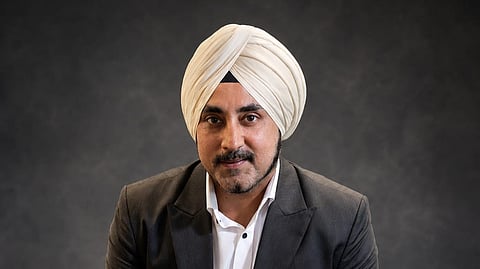
As the founder and CEO of WOWS Global, an investor matchmaking platform, he has built his career around bridging early-stage ideas with the people and opportunities that help them grow. Masala spoke with him about his entrepreneurial journey and the nuance of professional connection.
Growing up, what kind of environment did you come from? Were you always entrepreneurial?
I come from a lower-middle-class family in a small town in India, where I spent the first 23 years of my life. It was a typical middle-class upbringing: study hard, qualify professionally, and find a stable career.
I became a Chartered Accountant and joined the corporate world. Entrepreneurship came later, after working closely with businesses and realising that I was more energised by building and solving problems than by following a predictable path.
In hindsight, the instinct was always there; it simply took experience to surface.
What was the original vision for WOWS Global, and how has that vision evolved since you launched the company?
WOWS began by trying to solve a problem I experienced at Deliveree. I was part of the founding team, and the company grew from zero to a valuation of hundreds of millions of dollars.
My equity became materially valuable, but even after seven and a half years, I had no meaningful route to liquidity. The original vision was to build a secondary market for founders and early shareholders in Southeast Asia.
We launched in 2022, just as capital markets tightened sharply. Secondary transactions became harder, so we expanded into primary equity, then debt, and eventually added a service layer because transaction volumes were unpredictable.
The company has evolved, but its purpose remains improving private-market liquidity and efficiency.
What was the lightbulb moment that convinced you WOWS Global needed to exist?
There was no dramatic lightbulb moment. I was trying to solve my own problem, which made the idea personal.
In hindsight, it was not perfect market selection. I had chosen to build a secondary market in a region that still lacked enough major Initial Public Offering (IPO) and Merger and Acquisition (M&A) exits; the events that make secondary markets work.
Perhaps the real lightbulb moment came later, when I realised the original lightbulb needed replacing. That forced us to evolve.
Investor matchmaking sounds simple on paper, but what are the biggest challenges behind building trust between founders and investors?
Time is the biggest moat in this industry. Credibility cannot be manufactured through a website or a few introductions; it takes years of consistent work.
For the first one or two years, few people take you seriously. With discipline, trust begins to compound.
For founders, we must avoid bringing bad money or problematic investors. For investors, we must bring high-quality companies and reliable information.
Investor matching is ultimately less about introductions and more about governance, judgment, and credibility.
Technology is transforming every industry. How do you ensure technology enhances relationships rather than replacing the human element?
Technology creates better governance, better governance creates trust, and trust strengthens relationships.
We use technology and AI to organise information, identify inconsistencies, improve diligence, and reduce error. It helps us work faster and more accurately.
But it should not replace human judgment where character, credibility, and context matter. Its purpose is to improve decisions and leave more time for meaningful relationships.
In your view, how important is founder-market fit?
Founder-market fit is of utmost importance, often even before product-market fit. Almost every startup eventually pivots, so the founder must remain passionate about the market even when the product changes.
Ideally, founders should have expertise or lived experience in the problem. A founder can succeed outside their original domain, but the learning curve must be much faster.
Every founder should explain their unfair advantage: why they are better positioned than others to build this company. Ideas will change; that advantage must remain.
What is the hardest conversation you have ever had as a founder?
One is speaking with senior leadership when workload or responsibility is no longer shared equally. These conversations are difficult because each person has usually made meaningful contributions, even if the current situation is unbalanced.
Another was explaining to our team and board why WOWS needed to move from a technology-first model towards a service-led model. We wanted a highly scalable technology company, but we also had to survive.
It was not the story investors originally backed, but it was necessary. Sometimes a founder must choose survival over the prettier story.
How do WOWS Global and Settlr complement each other within your broader vision?
Settlr is a subsidiary of WOWS Global and supports our broader vision of providing holistic, end-to-end support to businesses.
Settlr helps companies establish and operate through incorporation, accounting, payroll, compliance, legal support, and fractional Chief Financial Officer (CFO) services.
WOWS helps them manage ownership, access investors, and raise equity or debt. Together, they create a connected ecosystem from formation and operations to growth capital and liquidity.
Which industries do you believe will produce Thailand’s next generation of unicorns?
I would watch healthcare, wellness, and hospitality, where Thailand already has global credibility and expertise. Small and Medium Enterprise (SME) lending is another major opportunity.
Traditional bank lending remains conservative, leaving many viable smaller businesses underserved. A company that can underwrite them intelligently and responsibly could achieve substantial scale.
I am also encouraged by the deep-tech and research-driven companies emerging from Thailand. Some of the most interesting businesses may come from laboratories and universities.
What book, person, or experience has had the greatest influence on your thinking?
The book is The Hard Thing About Hard Things by Ben Horowitz. It captures the reality that leadership often means managing stress and self-doubt while making painful decisions with incomplete information.
Its central lesson is that there is no fixed formula for success. The person is Elon Musk.
Whenever I feel I am trying to do too much, I look at the number and scale of problems he is attempting to solve. It reminds me that I am probably not even operating at five per cent of that workload, so I should stop complaining and keep pushing.

Your wife has built an impressive career in the legal profession. How do you support each other while managing demanding careers?
I am an entrepreneur today because my wife had a stable and successful career. I had the freedom to take chances because she ensured there was food on the table and our lifestyle was never materially compromised.
She gave me the runway to build without needing every month to be financially successful. Much of the credit for my entrepreneurial journey belongs to her.
As for how we manage two demanding careers, that question is probably better directed to her. She manages her career, the family, and, apparently, me as well.
What excites you most about the future?
The idea of a one-person unicorn excites me. With AI agents, I believe a single subject-matter expert may eventually build a billion-dollar company.
The more I use AI, the more plausible that feels. I am also interested in what happens if productivity rises so sharply that the world can produce far more than it needs.
Money may then become less central to how we define access, work, and quality of life. Finally, longevity could change our idea of lifespan.
I do not know whether living to 150 will become common, but health technology may force us to rethink careers, retirement, and the meaning of a lifetime.